
Home · Services · Climate risk
Service line

A climate-risk assessment that supports decisions as well as disclosure.

We identify the climate risks most relevant to the business, agree which ones require action and give each priority a clear owner, budget and response plan. The same work also provides the content needed for disclosure.

Ley 7/2021 Spain CSRD / TCFD EU SB 261 California M&A due diligence
The honest version

Climate-risk work should prepare the business for uncertainty, not pretend to predict it.

Companies often begin climate-risk work by trying to estimate exactly what will happen and how likely it is. That creates false precision. The more useful task is to identify the developments that could materially affect the business, understand the range of possible outcomes and decide what action makes sense despite the uncertainty.

Three rules shape every engagement we run:

Rule oneFocus the assessment on decisions, not predictions.

Stop trying to predict everything that could happen and how likely each thing is.

Concentrate on the developments that would matter most and on the actions that would leave the company better prepared across several possible outcomes.

Rule twoA numeric result is part of the process. It is not the goal.

Numbers are useful when they help someone choose, budget or act. A model that does not affect a decision has limited value.

Rule threeEvery phase must make your decision-making simpler and clearer.

Every workshop, model and report should improve the team's understanding or make the next decision easier. Tools such as En-ROADS and Climate Fresk are used only when they help people understand the issue and apply it to their work.

Try it yourself

Four kinds of climate risk. Four different responses.

Different types of climate risk require different responses. Use the exercise to match each example with the approach that best fits it.

Risk examples
Response approaches

Drag and drop, or tap an item and then tap its slot.

Correct.

Four kinds of risk, four different responses. That's where a real assessment starts.

The methodology

How an engagement runs.

What happens
Build the long list
  • Research plus interviews across your functions: physical, transition, strategic and systemic categories
  • Workshop introducing key concepts of risk thinking and transition strategy
  • Use climate-model data where it materially improves the assessment.
Screen for materiality: three lenses
  • Financial: plausible impact of at least 1.5% of revenue, or 2% of growth, in a single year
  • A material negative impact on the environment or on society
  • Any risk to the health and safety of employees or users: a hard red line
Output
A complete long list, narrowed to the risks that genuinely pass a materiality test, with the reasoning documented.
What happens
Group risks so decisions get easier
  • Grouped by causal mechanism: what actually drives this family of risks
  • Grouped by decision-owner and budget-owner: who decides, who pays
  • Grouped by timeframe, matched to your contract lengths and asset life
Score and rank honestly
  • Validated in working meetings with the functions that own each risk
  • Scored on imminence, short-term severity, long-term severity, and readiness
  • Every risk lands in a clear verdict: watch, plan, act, or urgent
Output
A ranked list of priority risks, supported by documented reasoning, plus a watch list for risks that do not yet justify action.
What happens
One-page fact sheet per priority risk
  • A measurable goal and acceptable-risk threshold
  • Mitigation tactics screened: can we do it, would it help, can we afford it
  • Implementation calibrated to our level of certainty about the risk
Financial modeling & reporting
  • Impacts modeled over 5, 10 and 15-year horizons under two NGFS scenarios
  • Documented assumptions and sensitivity analysis showing which results are robust and which depend heavily on uncertain inputs.
  • TCFD-aligned reporting content, ready for your legal disclosure
Output
Fact sheets, a financial model, disclosure-ready reporting, and a governance map giving every risk an owner, a working group, a budget and indicators to watch.
Climate-risk management takes time to embed across a business. The first engagement establishes the method, identifies immediate priorities and gives executives a practical basis for action.
Sample deliverable · a smart-mobility company

Pages from a real risk analysis.

Client name withheld; figures taken from the completed analysis.
88
risks screened
31
material risks
10
prioritized & budgeted
3
flagged urgent
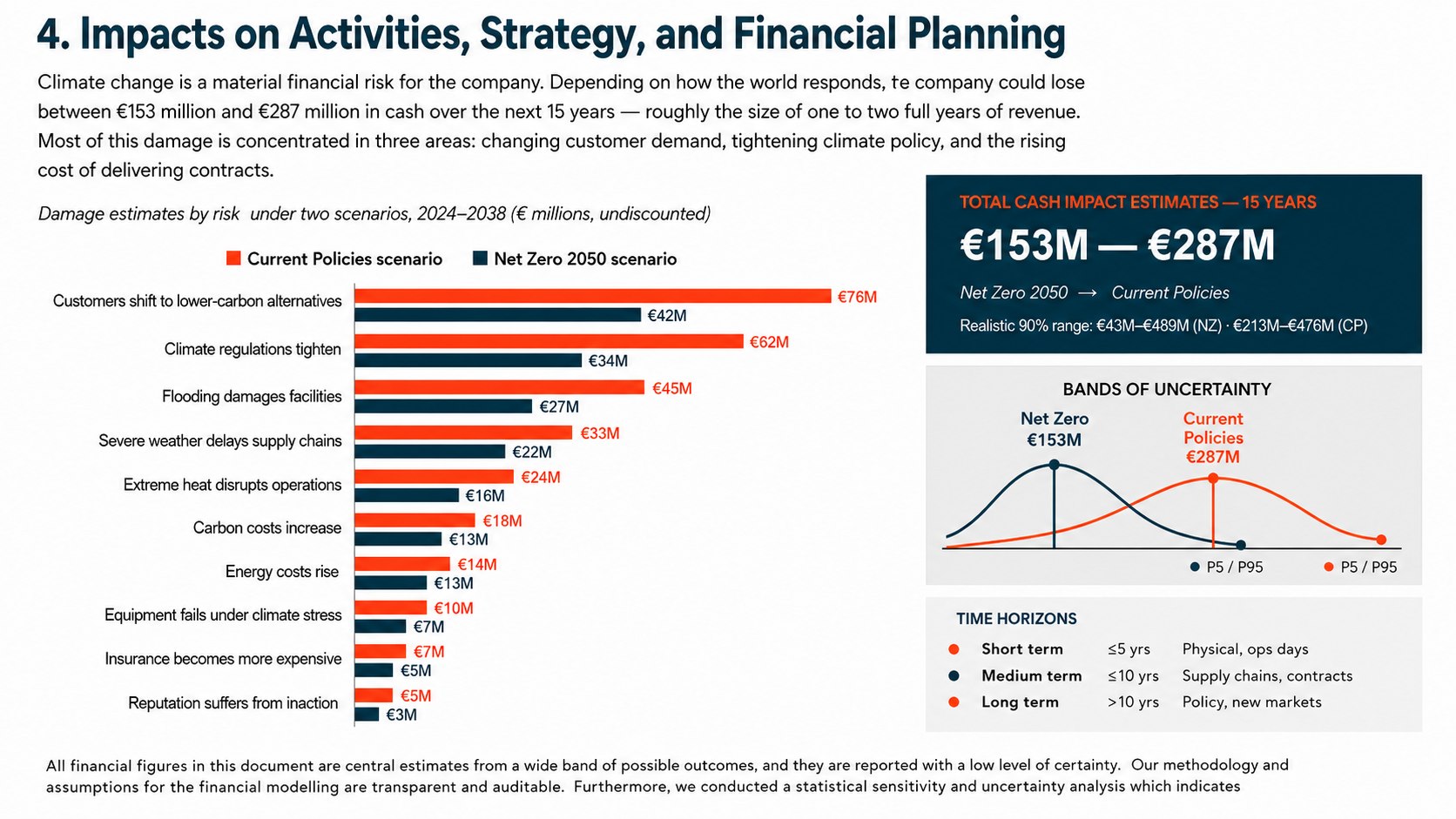
From the actual deliverable · two NGFS scenarios · 15 years

Estimated financial effects under two climate scenarios.

Deliverable page: damage estimates by risk under two scenarios, 2024 to 2038, with total cash impact of 153 to 287 million euros, uncertainty bands and time horizons

A page from the real analysis, name removed. Every figure carries its uncertainty band, and the methodology is transparent and auditable. Click to view full size.

Risk fact sheet · 1 of 10

Every priority risk on one page your board can read.

Extreme heat affecting employee safetyURGENT · 3.25
Goal: zero preventable heat illness. All exposed employees covered by a funded heat plan within 12 months.
Heat safety protocol✓✓✓
Shade & cooling upgrades✓✓✓
Heat-adjusted work scheduling✓✓✓
Certainty: HIGH. Direct evidence this is already happening, so action is justified now.
Owners: CEO · Ops · Health & SafetyIndicators & budget assigned

Operations hub

Dubai, UAE · projected to 2035
Extreme heatV. HIGH
DroughtV. HIGH
Extreme precipitationHIGH
WildfireLOW-MOD

Routine 45°C-plus summers, cooling-dependent operations, and acute water stress in a hyper-arid region.

Headquarters

Milan, Italy · projected to 2035
Extreme heatHIGH
DroughtHIGH
Extreme precipitationLOW-MOD
WildfireLOW

Heatwaves intensifying across the region, drought stressing the water supply, and a glazed building that depends on the grid to stay workable.

Regional office

Mexico City, Mexico · projected to 2035
Extreme precipitationHIGH
DroughtHIGH
Extreme heatMOD-HIGH
WildfireLOW

Urban flooding that blocks access and power, chronic stress on the metro water supply, and air-quality episodes from regional fires.

Physical risk at each site is only one part of the assessment. Each priority risk is also assigned to an owner and working group, with a budget and indicators, so the analysis becomes part of normal management.

Interactive tool · live demo

Adjust the assumptions to see how they change the estimated financial effect.

Scenario Explorer (best experienced on desktop)
Demo loading…One moment, please.

What good looks like.

AvoidEnsure

For you

Missing the opportunity to demonstrate leadership

You give colleagues a clear view of the priorities and the decisions required.

Slipping into check-the-box mode on an issue you personally care about

You make your strongest effort on the issues that matter to you

For your department

Failing to deliver the fundamental protective service your company expects

Your work meaningfully supports the broader business strategy

Failing to motivate action

The organization sees which actions are already under way and where further decisions are needed.

For your company

Trying to predict the future

You get better at making good decisions in the face of uncertainty

Believing you can prioritize risks without a real transition strategy and risk-thinking skills

The company understands how climate change may affect its strategy and where it has influence over the transition.

Who does the work

Climate-risk work led by an IPCC lead author.

The work is carried out directly by senior consultants.

Dr. Mark Trexler

Risk lead

Intergovernmental Panel on Climate Change lead author with 35 years advising 150+ international clients on climate risk. Mark founded the first corporate climate-risk consulting firm in the U.S. and co-authored the first textbook on climate risk for the London School of Economics.

He implemented the first-ever carbon offsetting projects and pioneered the concept of climate neutrality, helping the first companies go net zero in 1996. Clients have included HP, Nike, Suncor, the EPA, and Stonyfield Farm.

Keith Nelson

Consulting lead

Keith leads each engagement and brings in senior specialists when the work requires their expertise. This keeps the team experienced and the structure lean.

15 years managing large teams in complex international environments, on five continents. Executive MBA from ESADE, MA in International Politics from IBEI. Clients have included USAID, Coca-Cola, Merck, Cigna, Siemens Gamesa, and Allianz.

When a climate-risk assessment becomes necessary.

A disclosure law applies to you

More regulators now require climate-risk disclosure: the EU's CSRD and TCFD-aligned reporting, California's SB 261, Spain's Ley 7/2021. If you're required to show your work, it needs to hold up.

  1. Governance: who owns climate in your organization?
  2. Risk processes: how do you identify and prioritize risks?
  3. Risks & opportunities: what are the top risks you face?
  4. Impacts: what could they cost you?
  5. Strategic approach: what are you doing about it?
  6. Metrics & targets: how will you know it's working?

If you can't answer all six, that's the gap we fill.

You're buying, selling, or raising

During a transaction or fundraising process, investors may ask how material climate risks have been identified and managed. Gaps are much harder to address once due diligence is under way.

You're genuinely exposed

Your operations, suppliers or markets are exposed to physical hazards or transition changes, and management wants to prepare before the effects become urgent.

Not sure how exposed you really are?

A short introductory call can establish whether the exposure is material enough to justify a full assessment and where the work should begin.

Book an intro call
AI assistant · Speak with our AI assistant
Assistant